
Every entrepreneur knows the frustration: you have a brilliant business idea, you can see the market opportunity clearly, you know exactly what your customers need—but you can’t build it. The technical barrier between concept and reality has killed more promising startups than bad ideas ever could.
This is the problem Atoms.dev was built to solve, and after analyzing the platform extensively, I can confidently say it’s one of the most significant solutions to emerge in 2024 for non-technical founders and solo entrepreneurs.
The Real Problem: The «Execution Gap» That Destroys Great Ideas
Let’s be honest about what actually stops most business ideas from becoming reality. It’s rarely a lack of market demand or poor timing. The real killer is what I call the «execution gap»—the massive distance between having an idea and having a functional product people can actually use and pay for.
This gap manifests in several brutal ways:
1. Development Costs That Drain Your Runway Before You Launch
Hiring developers is expensive. A freelance full-stack developer costs anywhere from $50 to $150 per hour. Building even a basic MVP (minimum viable product) typically requires 200-400 hours of development time. Do the math: you’re looking at $10,000 to $60,000 just to get a first version live—before you’ve validated anything with real customers.
For bootstrapped founders or those without significant capital, this cost structure is prohibitive. Your savings disappear into development costs before you can even test whether customers actually want what you’re building.
2. Time-to-Market That Lets Competitors Beat You to Launch
Even if you can afford developers, time becomes your enemy. Traditional development cycles move slowly: requirements gathering, design mockups, frontend development, backend architecture, database setup, API integration, testing, deployment. Each phase takes weeks.
By the time your MVP is ready three months later, the market may have moved on, a competitor may have launched, or your initial assumptions may have changed. In fast-moving markets, speed isn’t just an advantage—it’s survival.
3. Technical Complexity That Overwhelms Non-Technical Founders
Perhaps the most insidious problem is the sheer cognitive load of managing technical projects when you don’t speak the language. You’re suddenly dealing with:
- Frontend frameworks (React? Vue? Angular?)
- Backend architecture (Node.js? Python? Serverless?)
- Database choices (PostgreSQL? MongoDB? Firebase?)
- Authentication systems (OAuth? JWT? Auth0?)
- Payment processing (Stripe integration, webhook handling)
- Hosting and deployment (AWS? Vercel? Heroku?)
- SSL certificates, DNS configuration, API rate limiting
Each decision requires technical knowledge you don’t have. You’re forced to trust developers’ recommendations without understanding the trade-offs. This creates dependency, delays, and often suboptimal choices that haunt you later.
4. The Iteration Paralysis
Here’s what kills even well-funded startups: every change becomes a negotiation. Customer feedback suggests you need to modify a feature? That’s another sprint cycle, another round of estimates, another week or two of development.
The ability to iterate rapidly based on user feedback is what separates successful products from failures. But when each iteration requires coordinating with developers, waiting for availability, and paying for additional development hours, your iteration speed grinds to a halt.
You end up locked into your original assumptions because pivoting is too expensive and time-consuming.
Enter Atoms.dev: Closing the Execution Gap with AI-Powered Development
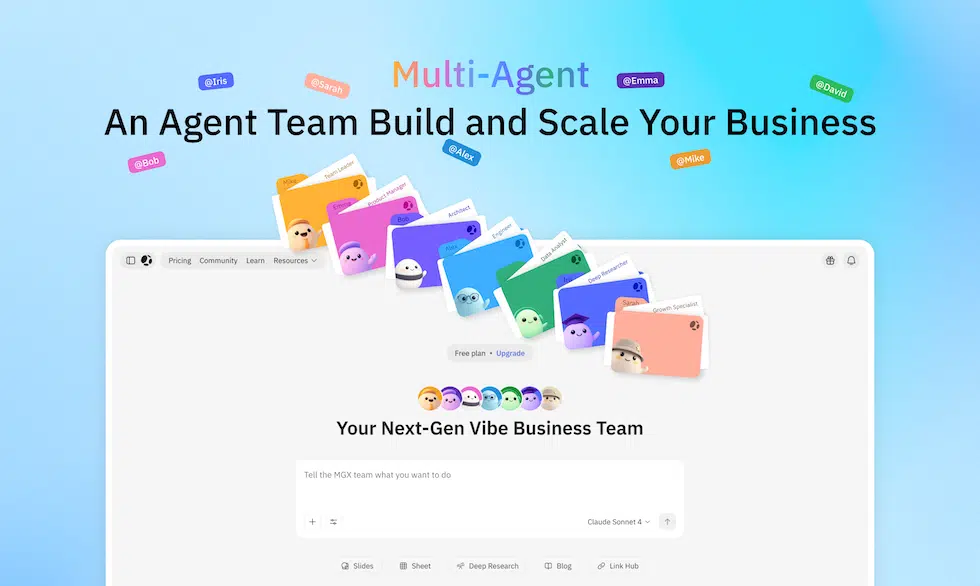
Atoms.dev attacks this problem from a fundamentally different angle. Instead of trying to make traditional development faster or cheaper, it replaces the entire development workflow with a coordinated team of AI agents that can take you from idea to live, revenue-ready application in hours instead of months.
How Atoms.dev Actually Works
When you describe what you want to build in Atoms.dev, you’re not just getting code generation (like with Cursor or GitHub Copilot). You’re engaging with specialized AI «employees» that mirror a real product development team:
The Research Agent analyzes your market, identifies competitors, suggests positioning, and helps you understand what similar products are doing. This is the strategic layer most AI coding tools completely skip.
The Product Manager Agent takes your high-level idea and breaks it down into specific features, user flows, and requirements. It asks clarifying questions you might not have thought of: «Should users be able to edit their profile? Do you need password reset functionality? Will there be different user roles?»
The Design Agent creates the UI/UX structure—not just generating random components, but thinking about user experience, information architecture, and visual hierarchy.
The Engineering Agents handle both frontend and backend development. They don’t just write code—they architect the system, set up databases, create API endpoints, implement authentication, integrate payment processing, and handle the thousands of technical details that would normally require specialized knowledge.
The Deployment Agent takes the finished product and publishes it live with proper hosting, SSL certificates, CDN configuration, and monitoring—all automatically.
This multi-agent orchestration is what sets Atoms.dev apart. Each agent has specialized knowledge and works with the others to produce a coherent, production-ready application.
The «Race Mode» Advantage
One of Atoms.dev’s most innovative features is «Race Mode,» where multiple AI models (Claude, GPT-4, DeepSeek, and others) work on your problem simultaneously. You can then choose the best implementation from multiple options.
This solves a major problem with AI-generated code: sometimes you get a mediocre result. With Race Mode, you’re essentially getting multiple development approaches and can pick the one that best fits your needs or combines elements from different solutions.
The Atoms Cloud Backend: Full-Stack Apps Without Infrastructure Headaches
One of the most impressive aspects of Atoms.dev is how it handles backend complexity. Most AI coding assistants can generate frontend code reasonably well, but backend systems—databases, authentication, APIs, serverless functions—require significantly more architectural knowledge.
Atoms Cloud automatically detects when your project needs backend infrastructure and enables it for you:
- User Authentication: Sign-up, login, password reset, email verification, session management—all configured and working
- Database Setup: Automatic table creation, relationships, indexes, and query optimization based on your data model
- API Generation: RESTful endpoints with proper error handling, validation, and documentation
- Payment Integration: Stripe connection with webhook handling for subscriptions, one-time payments, and billing management
- File Storage: Secure file uploads, storage, and retrieval with proper access controls
- Real-time Features: WebSocket connections for live updates, notifications, and collaborative features
This isn’t just infrastructure-as-code—it’s infrastructure-as-intent. You describe what you need in plain language, and Atoms configures the entire backend stack to support it.
For non-technical founders, this is transformative. You don’t need to understand the difference between REST and GraphQL, or debate SQL versus NoSQL databases. The system makes these architectural decisions based on your specific requirements.
Real-World Example: From Idea to Live E-Commerce in One Session
To understand the power of this approach, consider a real documented example: building a complete e-commerce store for custom stickers using Atoms.dev.
The founder started with a simple prompt: «Build an e-commerce site where users can browse sticker designs, add them to cart, and purchase using Stripe.»
Over the course of a few hours (including refinements and bug fixes), Atoms.dev:
- Created a product catalog interface with image galleries
- Built a shopping cart with quantity management
- Set up user authentication (signup, login, profile management)
- Integrated Stripe for payment processing with proper webhook handling
- Created an admin panel for managing products and viewing orders
- Set up a database to store products, users, and order history
- Deployed the entire application live with a custom domain
The result? A fully functional online store that can accept real payments and fulfill real orders—built in the time it would normally take just to have an initial consultation with a development agency.
More importantly, when the founder wanted to add features based on early customer feedback (bulk discounts, design customization options), those changes took minutes instead of requiring another development sprint.
The Iteration Advantage: Why This Changes Startup Economics
The real business value of Atoms.dev isn’t just the initial build speed—it’s how it transforms your ability to iterate and improve based on market feedback.
Traditional development creates an adversarial relationship with change. Every modification means:
- Scoping work and estimating time
- Waiting for developer availability
- Explaining requirements (often losing nuance in translation)
- Paying for additional development hours
- Testing and deployment cycles
This friction means founders often stick with suboptimal features because changing them is too expensive and time-consuming. You end up compromising your product vision based on development constraints rather than customer needs.
With Atoms.dev, iteration becomes conversational:
«The signup form is too long—let’s make email and password the only required fields initially and collect other info later.»
«Add a ‘Save for Later’ button to the product pages.»
«Change the pricing page to show monthly pricing more prominently than annual.»
Each change happens in minutes. You’re no longer constrained by development velocity—you’re constrained only by how quickly you can process customer feedback and make decisions.
This fundamentally changes startup economics. Your burn rate drops dramatically (no expensive developer salaries or contracts). Your iteration speed increases exponentially (changes in minutes instead of weeks). Your ability to find product-market fit accelerates because you can test hypotheses rapidly.
Who Benefits Most from Atoms.dev?
While Atoms.dev is powerful, it’s particularly valuable for specific founder profiles:
Solo Founders and Non-Technical Entrepreneurs
If you understand business, marketing, and your target customers but lack coding skills, Atoms.dev gives you technical leverage you’ve never had before. You can build, test, and iterate on product ideas without hiring a technical co-founder or contracting with developers.
This is especially powerful for validating ideas before significant investment. Instead of spending $20,000-$50,000 on an MVP that might fail, you can build and test for essentially the cost of the Atoms subscription.
Indie Hackers and Serial Launchers
For entrepreneurs who constantly have new ideas and want to test multiple concepts, Atoms.dev enables a portfolio approach. You can launch 3-5 different micro-SaaS products in the time it would normally take to build one, then double down on whichever gains traction.
The ability to rapidly prototype and deploy means you’re no longer forced to bet everything on a single idea. You can experiment, learn, and pivot based on actual market response.
Small Agencies and Consultants
For small agencies that serve clients needing custom tools, internal dashboards, or client portals, Atoms.dev dramatically improves project economics. You can deliver projects faster, handle more clients simultaneously, and maintain better margins.
The speed advantage also lets you offer rapid iteration to clients, turning development from a waterfall process into an agile, collaborative experience.
Developers Who Want Leverage
Interestingly, professional developers are also finding value in Atoms.dev—not to replace their skills, but to handle the tedious boilerplate that consumes so much development time. Authentication systems, CRUD operations, basic styling, deployment pipelines—Atoms can generate these in minutes, freeing developers to focus on complex business logic and performance optimization.
Realistic Limitations and Trade-offs
To maintain credibility, it’s important to acknowledge where Atoms.dev isn’t the right solution:
Complex Enterprise Systems: If you’re building a system with intricate business logic, heavy performance requirements, or complex integrations with legacy systems, you’ll still need experienced developers. Atoms.dev excels at MVPs and straightforward applications, not replacing senior engineering teams on complex projects.
Highly Customized UI/UX: While Atoms can create clean, functional interfaces, achieving pixel-perfect custom design or highly specialized user experiences may require manual refinement. The design output is professional and modern, but not bespoke.
Learning Curve for Advanced Features: While basic usage is intuitive, getting the best results from Atoms requires learning how to prompt effectively and understand the system’s capabilities. The more specific and structured your prompts, the better the output.
AI Quirks and Occasional Errors: Like all AI systems, Atoms occasionally produces code that needs debugging or generates implementations that aren’t quite right. The difference is that fixing these issues is conversational («that button isn’t working—fix the click handler»), not requiring deep technical knowledge.
Pricing and ROI Considerations
While specific pricing varies and should be checked on their website, the ROI calculation for most founders is straightforward:
Traditional development: $10,000-$60,000 for MVP + $5,000-$20,000/month for ongoing development and maintenance = $70,000-$300,000 in first year.
Atoms.dev approach: Subscription cost + your time = Likely under $5,000 in first year.
Even if Atoms.dev required manual refinement and debugging that consumed significant time, you’d still save tens of thousands of dollars and achieve faster time-to-market.
More importantly, the cost structure flips from front-loaded to incremental. Instead of needing $30,000 before you launch, you can start building immediately and scale investment as revenue grows.
The Bigger Picture: Democratizing Software Creation
Atoms.dev represents something larger than just a development tool—it’s part of a fundamental shift in who can build software companies.
For decades, starting a tech company required either (1) being a developer yourself, (2) finding and convincing a technical co-founder to join you, or (3) raising capital to hire developers. These barriers meant that countless great business ideas from non-technical people never became reality.
We’re now entering an era where business acumen, market understanding, and customer empathy matter more than coding ability. The technical implementation is increasingly becoming a commodity that AI can handle, while the human skills of identifying opportunities, understanding customers, and building businesses remain irreplaceable.
Atoms.dev is at the forefront of this democratization. It’s not trying to replace developers—professional engineers will always be needed for complex systems. Instead, it’s empowering a new class of entrepreneurs to build and launch products that would have been impossible for them just a year ago.
Final Verdict: Who Should Use Atoms.dev?
If you’re a non-technical founder with a clear business idea but no way to build it affordably and quickly, Atoms.dev is potentially game-changing. The platform directly solves your biggest problem: turning ideas into functional, revenue-ready applications without expensive developers or long timelines.
If you’re an indie hacker who wants to test multiple product ideas rapidly, Atoms.dev gives you the leverage to operate like a small development team while remaining a solo founder.
If you’re currently stuck in «planning paralysis»—endlessly refining your idea because you can’t afford to start building—Atoms.dev removes that barrier. You can start building today, see results in hours, and iterate based on real feedback instead of hypothetical planning.
The execution gap that kills most startup ideas is closing. Tools like Atoms.dev are making it possible for business-minded founders to build, launch, and iterate on software products with speed and economics that were unthinkable just a few years ago.
The question is no longer «Can I afford to build this?» but rather «Is this idea worth pursuing?» And that’s exactly the question founders should be asking.
Getting Started with Atoms.dev
If you want to explore Atoms.dev for your next project, here’s the recommended approach:
- Start with a specific, bounded project. Don’t try to build your entire vision at once—pick one clear use case or feature set.
- Be detailed in your initial description. The more specific you are about user flows, features, and desired behavior, the better the initial output.
- Expect to iterate. Your first version will be good but not perfect—plan to refine based on what you see.
- Test with real users quickly. The speed advantage only matters if you actually get to market and gather feedback.
- Focus your energy on business problems, not technical problems. Let Atoms handle authentication and databases while you figure out pricing, positioning, and customer acquisition.
The biggest risk isn’t that Atoms.dev won’t work—it’s that you’ll spend months planning the perfect product instead of launching something good enough to test with real customers.
The execution gap is closing. The question now is, what will you build?
Ready to turn your idea into reality? Visit Atoms.dev and start building today.